

Blog
Most built environments are subject to accessible design and construction requirements under the building code and applicable local, state, and federal accessibility laws. Even small, unintentional misunderstandings of requirements can lead to complaints and, in some cases, costly court proceedings. We’ll suggest best practices to avoid errors that leave building owners and other key stakeholders vulnerable to accessibility litigation.

No building owner or property manager wants to receive notice that an accessibility complaint has been filed.
What’s more frustrating is discovering that the alleged noncompliance stems from decisions made much earlier, sometimes during planning and design, rather than from intentional disregard during construction.
For the vast majority of buildings (there are very few exceptions), accessibility requirements apply. These requirements are established through a combination of building codes and disability rights laws, including the Americans with Disabilities Act (ADA), the Fair Housing Act (FHA), and Section 504 of the Rehabilitation Act, among others.
Understanding which requirements apply to a particular building and how they must be implemented in practice is complex and often misunderstood.
That complexity is where problems arise. Seemingly minor assumptions, shortcuts, or documentation gaps can expose project teams and owners to risk long after a building is occupied.
This blog post marks the beginning of an ongoing effort to share the real‑world misunderstandings that can (and do) lead to accessibility litigation.
SWA’s Peter Stratton, Managing Director of Accessibility Services, has served as an expert witness in numerous accessibility litigation cases. Through that work, he has seen how design decisions are scrutinized during mediation and in court, and how misinterpretations of accessibility requirements can become central issues in a case.
In recognition of Fair Housing Month, Peter is sharing some best practices for reducing litigation risk in residential projects:
When you select a HUD‑approved safe harbor document for FHA compliance, HUD requires that you follow that document in its entirety. Trying to combine requirements from multiple safe harbors may feel practical, but it can increase the risk of accessibility litigation. Here’s why.
The U.S. Department of Housing and Urban Development (HUD) has approved several safe harbor documents that architects may use to demonstrate compliance with the design and construction requirements of the Fair Housing Amendments Act (FHAA).


The Fair Housing Act Design Manual and the 2018 International Building Code are both approved safe harbor documents.
The Fair Housing Act Accessibility Guidelines (the Guidelines), arguably the least stringent of all HUD-approved safe harbors, is what HUD uses to evaluate projects for FHA compliance.
In other words, HUD will identify noncompliance with the FHA where any provision of the FHA Guidelines is violated. However, a violation of the Guidelines alone is not necessarily an indication of noncompliance with the FHAA, because there are other HUD-approved safe harbors from which to choose.
If a safe harbor other than the Guidelines is used to design a project and all provisions of that safe harbor that address the FHAA’s design and construction requirements are met, then FHAA compliance is achieved. In this case, the architect can rebut HUD’s findings of noncompliance with the FHAA due to violations of the Guidelines by demonstrating compliance with the selected HUD-approved safe harbor.
For example, case history shows that when the distance between the centerline of a toilet and the adjacent side wall is not exactly 18 inches, then noncompliance with the Guidelines is identified. However, other more recent HUD-approved safe harbors permit the distance between the centerline of a toilet and the adjacent side wall to be within the range of 16 and 18 inches. If the distance is not exactly 18 inches, then HUD will identify noncompliance with the Guidelines. To rebut that finding, the architect can demonstrate use of a safe harbor that permits the 16-to-18-inch range, and the problem is solved.
Here’s where it gets tricky in litigation.
From HUD’s perspective, once a safe harbor is selected, the project must comply with all provisions of the safe harbor that address the FHAA’s design and construction requirements to ensure the full benefit of the safe harbor.
According to guidance from HUD and the US Department of Justice (DOJ) “The benefit of a ‘safe harbor’ may be lost if, for example, a designer or building chooses to select provisions from more than one of the HUD-approved ‘safe harbor’ documents…”
If architects do not select one safe harbor and stick with it consistently, then “they bear the burden of demonstrating that the dwelling units nonetheless comply with the Act’s design and construction requirements.”
“Cherry picking” provisions from various HUD-approved safe harbors to rebut findings of noncompliance rather than following the joint guidance provided by HUD and DOJ to rebut findings of noncompliance by citing compliance with the provisions of only one HUD-approved safe harbor is often a subject of discussion in mediation and litigation. And it plays out in a myriad of ways.
Best practice is to always stick with one HUD-approved safe harbor to demonstrate compliance with FHAA.
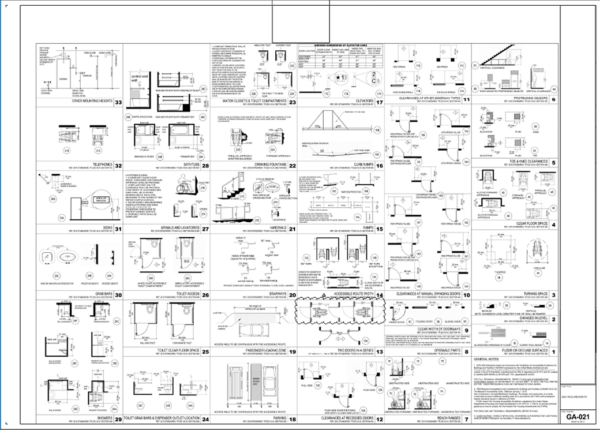
General notes and standard details can give teams the sense that accessibility compliance is covered. The problem is that when accessibility details are tucked away on the G‑Series instead of clearly reflected in the design drawings, significant gaps can emerge. Those gaps are often what lead to accessibility litigation.
The G-Series (General) pages of an architectural set of plans typically include high-level general information about the project, including, for example: the code analysis, drawing indices, general notes, etc.

Oftentimes, we find that general accessibility details are copied from various technical documents and pasted onto the general pages. These details, however, are often not aligned with the design of the project.
For example, general details for a galley and U-shaped kitchen from the A117.1-2009 technical standard might be found on the G-Series, but none of the apartment designs found in the A-series (architectural pages) include galley or U-shaped kitchens aligned with the kitchen details found on the G-Series.
When a project is cited for noncompliance with the FHAA, an inspection ensues as part of the discovery process. An inspection might reveal an alleged violation of required clearance between opposing elements in kitchens. For example, the distance between the face of a refrigerator and the opposing island countertop might be less than the required minimum 40 inches and therefore, a violation of the FHAA is identified.
What happens next varies depending on agreements made during the litigation process, but often a review of the plans is conducted.
The purpose of the plan review is to determine whether the alleged noncompliance of less than 40 inches between opposing elements in the kitchen was the result of a design or construction error/omission. In other words, was the project designed incorrectly or, was it designed correctly but constructed incorrectly.
A plan review might reveal that kitchen plans did not include enough detail to communicate the required minimum distance between the refrigerator and opposing island countertop. As a result, it might be determined that the kitchen plan omitted the necessary information to ensure compliance of the built condition.
The determination of a design omission by the architect might be rebutted by citing that the general details cut from an accessibility standard and pasted on the G-Series of pages clearly includes a dimension of 40-inches minimum between the face of the refrigerator and the opposing wall. That might be fine – if the kitchen design on the A-series matched the kitchen design found on the G-series.
In our example, the built condition included a kitchen with a refrigerator that opposed an island countertop and the general kitchen detail found on the G-series included a kitchen with a refrigerator opposing a wall. And the kitchen detail on the G-series does not include an island that exists in the built condition.
So how can someone justify a compliant design by citing general details on the G-series that are not at all aligned with the design of the project? In our opinion, they cannot. But this is often a big part of discussions during mediation/litigation.
It is best practice to include the appropriate amount of detail into the A-series and avoid relying on general details on the G-series.
After all, builders construct projects based on the actual design and not on details found in the G-series. In fact, over-detailing the A-series is an added level of protection that we recommend.
If a space is adaptable, that does not mean it is accessible. Accessible design should give people with disabilities equal access to buildings without having to make modifications. Relying on adaptable design to meet accessibility requirements puts you at risk for litigation.
Adaptability is design that can be modified to suit a future need. For example, reinforced walls around the toilet in a dwelling unit bathroom to allow for the future installation of grab bars, should they be needed, is an example of adaptable design.
The unit is provided to the resident with without grab bars installed, with reinforcement in place for future adaptability. If a resident requires grab bars in the future for whatever reason, they’re easily mounted into the reinforcement installed during construction. This is design that meets potential future needs, i.e., adaptable design.
Conversely, accessible design is intended to accommodate the needs of people with disabilities without having to make a future modification.
For example, the clear width provided by user passage doors must be at least 32 inches; receptacle outlets on walls must be located more than 15 inches above the floor; operable parts of thermostats must be located below 48 inches AFF; and space must be available beyond the door swing in bathrooms to allow someone in a wheelchair to enter and close the door. Among many others, these accessible design requirements must be achieved during construction and in place at the time of occupancy.


During litigation, the line between adaptable and accessible design is sometimes blurred.
When a light switch that is required to be installed 48 inches above the floor winds up at 51 inches above the floor, a violation exists. Some will offer that a violation does not exist because the light switch can be easily lowered should a resident need easier access to the switch. However, the height of a light switch is stipulated and must be met.
In other words, the height of a switch is not permitted to change based on a future need; it must be in place at a specified height at the time of occupancy. The height of light switches is not an adaptable feature. Because the height is set by requirements, it is an example of accessible design.
To claim that everything identified during discovery as noncompliant can be easily modified because the FHAA allows adaptable design is not a sound defense. Based on the “everything is adaptable” rationale, there is no point to design and construction requirements.
Accessible design and construction requirements must be met. It’s important to recognize that design that is permitted to be adaptable and accessible is addressed in the FHAA and associated HUD-approved safe harbors, i.e., design that is permitted to change based on a future need is specifically contemplated in the requirements.
If adaptability is not contemplated, then it is not permitted.
It is always best practice to design a project in full compliance with the requirements and to not rely on the adaptability defense.
The most effective way to avoid accessibility litigation is to get it right from the start: address accessibility intentionally and consistently from the earliest stages of design through construction and occupancy.
If litigation does occur, working with an expert who understands both accessibility requirements and the legal process can help clarify what went wrong and what steps are needed to address it.
When we support clients during accessibility litigation, our role typically includes:
We also regularly share guidance on accessible design, compliance, and risk reduction here on our blog throughout the year.
You can reach our Accessibility Team anytime by filling out our contact form.
Author: Peter A. Stratton, Managing Director of Accessibility Services at SWA
Steven Winter Associates